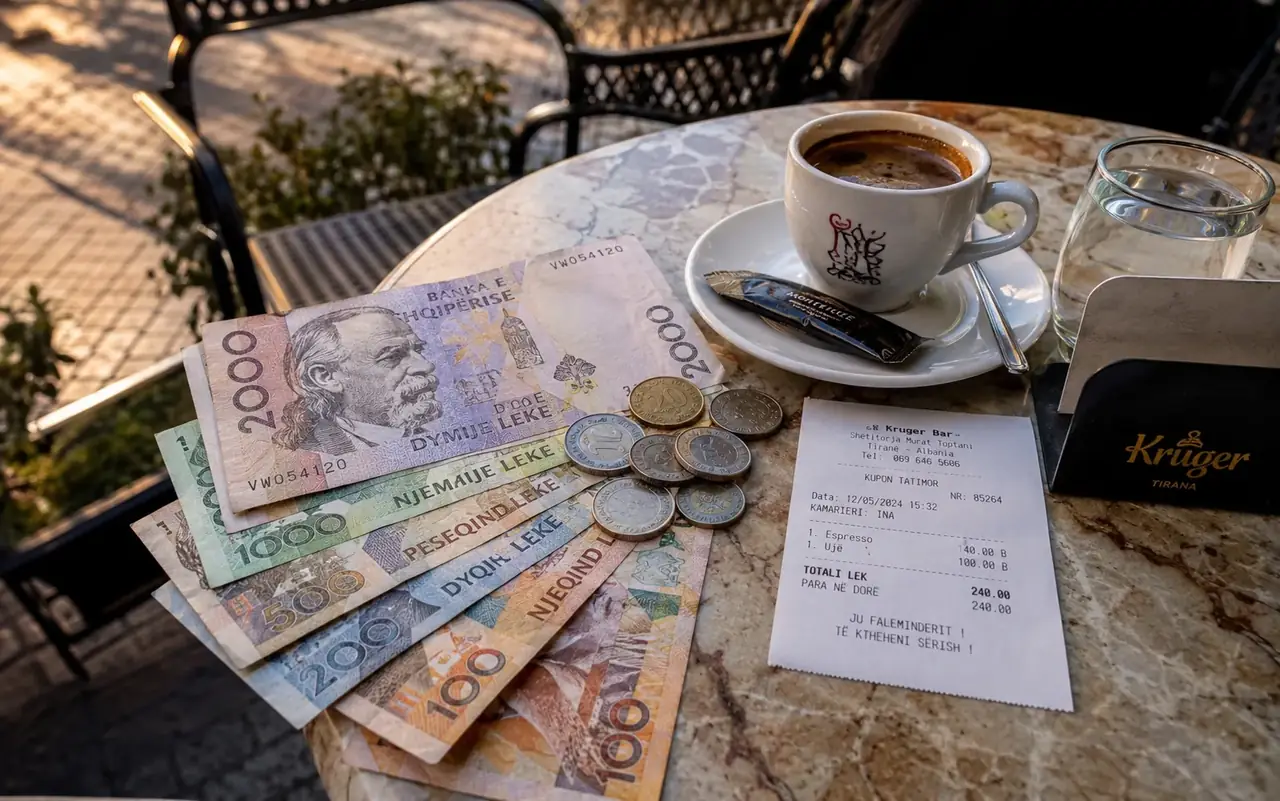
Albania's currency is the lek (ALL). Cards are catching up fast, but cash is still the norm for taxis, furgon minibuses, small shops, markets and much of rural Albania. The practical approach is to carry some lek at all times, use a card where you can, and keep euros as a backup rather than a primary currency.
The lek, Albania's currency
The lek cannot be bought outside Albania, so visitors get it either from a cash machine or by exchanging euros or dollars once they arrive. Albania floats the lek freely against other currencies, and the Bank of Albania publishes a daily reference rate calculated from interbank quotations. On 2 November 2026, that rate was €1 = 90.89 lek and $1 = 81.12 lek. Rates move from day to day, so check the Bank of Albania's site for the current figure rather than relying on an older number.
The current banknote series has six denominations: 200, 500, 1,000, 2,000, 5,000 and 10,000 lekë, rolled out gradually between 2019 and 2022, according to the Bank of Albania. Older notes of the same denominations from the mid-1990s (and a 2008 2,000-lekë note) remain legal tender until the bank announces a withdrawal date. Coins come in 1, 5, 10, 20, 50 and 100 lekë.
Small notes matter
Shops, cafés and taxi drivers often struggle to change a 5,000 or 10,000-lekë note for a small purchase. It is worth asking for change in smaller notes when you withdraw or exchange money, and keeping some 500 and 1,000-lekë notes for coffees, snacks and short taxi rides.
Getting lek: ATMs and exchange offices
ATMs are easy to find in Tirana and other towns and cities, and accept international Visa and Mastercard. They are much scarcer in rural areas and in the mountains, so withdraw what you need before heading out of the larger towns, including before hikes such as the Theth to Valbona route.
Fees vary by bank and by card, and estimates from travel guides are inconsistent, so treat any single figure with caution. Expect two charges: a fee from the ATM operator itself, and a separate foreign transaction fee from your home bank or card provider, commonly a percentage of the amount withdrawn. The ATM screen will show its own fee before you confirm the transaction, so check it there rather than guessing. If the machine offers to convert the amount into your home currency on the spot ("dynamic currency conversion"), decline it and let your own bank do the conversion; the ATM's own exchange rate is usually worse.
Licensed exchange offices (zyra këmbimi) are common in city centres and offer another way to get lek, often at a better rate than withdrawing on a card, according to Exit News. Rates differ between offices, so it is worth comparing the boards at two or three before changing a large amount. The usual advice is to change only a small sum on arrival, enough for a taxi or the first day, and do the bulk of your exchanging in town once you have compared rates.
| Method | Best for | Watch out for |
|---|---|---|
| ATM withdrawal | Topping up lek quickly in any town | An ATM operator fee plus your own bank's foreign transaction fee; decline on-screen currency conversion |
| Exchange office | Changing a larger sum of euros or dollars at once | Rates vary between offices, so compare a couple before committing |
| Card payment | Hotels, larger restaurants and shops, mainly in Tirana and tourist areas | Not accepted everywhere; some businesses add an illegal surcharge for card use |
Paying with euros, and paying by card
Euros are widely accepted in hotels, larger restaurants and tourist-facing businesses, especially in Tirana and along the coast, but you will usually get change in lek, and the exchange rate applied is set by the business rather than the bank. Exit News advises agreeing the rate before you pay if you are handing over euros.
Card payments are growing quickly. Bank of Albania figures reported by Albanian Daily News show 38,662 active point-of-sale terminals in the country by mid-2026, up 23.7% since the start of the year and 38.2% year on year, roughly three times the number in 2020. Albanians and visitors made about 16 million card payments at those terminals in the first half of 2026, 28% more than a year earlier, worth a combined 58.3 billion lek, up 21%. Card payments now outnumber cash withdrawals at ATMs, accounting for about 56 of every 100 card transactions, with tourist spending at hotels and restaurants cited as one driver of the growth.
Part of that growth is being pushed by regulation. Amendments to Albania's tax procedures law approved in December 2025 require transport operators, taxis, guesthouses, hotels and other accommodation providers to install card terminals, according to reporting by the compliance-news service Fiscal Requirements, which cites a deadline of 31 December 2026 for most remaining cash-only businesses. Transport operators have pushed back, arguing that card processing fees of around 2–3% are hard to absorb on low-value bus and taxi fares, and some tolerance in enforcement is expected at first.
Even so, plenty of smaller businesses, market stalls, furgons and village guesthouses remain cash-only, particularly outside Tirana and the main coastal resorts. Carry enough lek to cover a day's spending as a backup even where you expect to pay by card.
Card surcharges
Some businesses, especially in tourist areas, add an extra charge for paying by card rather than cash. In a July 2025 television interview reported by the Albanian Association of Banks, the association's secretary general, Spiro Brumbulli, described this practice as illegal and unacceptable. If a business tries to charge you more for using a card, it is reasonable to ask why, or to pay in cash instead.
Tipping
Tipping in Albania is appreciated but not expected in the way it is in, for example, North America. In restaurants, rounding the bill up to the next note is normal for a small meal, and around 10% is a reasonable tip for a larger bill, according to Rough Guides. For a coffee or a drink, rounding up to the nearest note or two is common. For taxis, hotel staff and tour guides, there is no fixed rule; a small cash tip for good service is welcome but no one will expect or chase one.
Know before you go
- Carry cash. Taxis, furgons, market stalls and many small businesses, especially outside Tirana and the coast, don't take cards.
- Withdraw lek in a town before heading into rural or mountain areas, where ATMs are scarce.
- Decline dynamic currency conversion at ATMs and card machines; choose to be charged in lek.
- Ask for smaller notes when you withdraw or exchange money, since a 5,000 or 10,000-lekë note can be hard to break.
- Compare rates at a couple of exchange offices before changing a large amount, rather than using the first one you see.
- Check your card's foreign transaction fees before you travel, and check the ATM's own fee on screen before confirming a withdrawal.
Frequently asked questions
Frequently Asked Questions
Can I pay in euros in Albania?
Yes, in most hotels, larger restaurants and tourist-facing shops, especially in Tirana and along the coast. You'll usually get change in lek, and the business sets its own exchange rate, so it's worth agreeing the rate before you pay.
Are credit and debit cards widely accepted in Albania?
Card acceptance is growing quickly: Bank of Albania data shows card payments and the number of card terminals both rose sharply in 2026. Hotels, larger restaurants and shops in Tirana and tourist areas generally take cards, but many small businesses, market stalls, furgons and village guesthouses are still cash-only.
How much do ATMs in Albania charge for foreign cards?
It varies by bank and by your own card provider, so check the fee shown on the ATM screen before confirming. Expect an ATM operator fee plus a separate foreign transaction fee from your home bank, and always decline any on-screen offer to convert the amount into your home currency.
Is tipping expected in Albania?
No. Tipping is appreciated but not obligatory. Rounding up a restaurant bill is normal, and around 10% is reasonable for a larger bill. For taxis, guides and hotel staff, a small cash tip for good service is welcome but not expected.
Where is the best place to exchange money in Albania?
Licensed exchange offices in city centres often give better rates than the airport or a card withdrawal, but rates vary between offices, so compare a couple before changing a large amount. Change only a small sum on arrival for your first taxi or meal.
Sources8
- Bank of Albania: Official exchange rate, 2026-11-02
- Bank of Albania: Banknotes in circulation, 2026-11-03
- Bank of Albania: Coins in circulation, 2026-11-03
- Albanian Daily News: Tourism Boosts POS Terminals, Card Payments up, 2026-09-01
- Albanian Association of Banks (AAB): Electronic payments on the rise: Benefits for citizens and a boost to economic formalization, 2025-07-07
- Fiscal Requirements: Albania mandates POS terminals for transport and lodging sectors amid industry pushback, 2026-06-26
- Exit News: A Tourist's Quick Guide to Albania
- Rough Guides: Customs and etiquette in Albania
About this article
Written by the YourAlbania Editorial Team, which covers travel, property and investment in Albania. Every article links to the sources it is based on.
Published 3 November 2026.