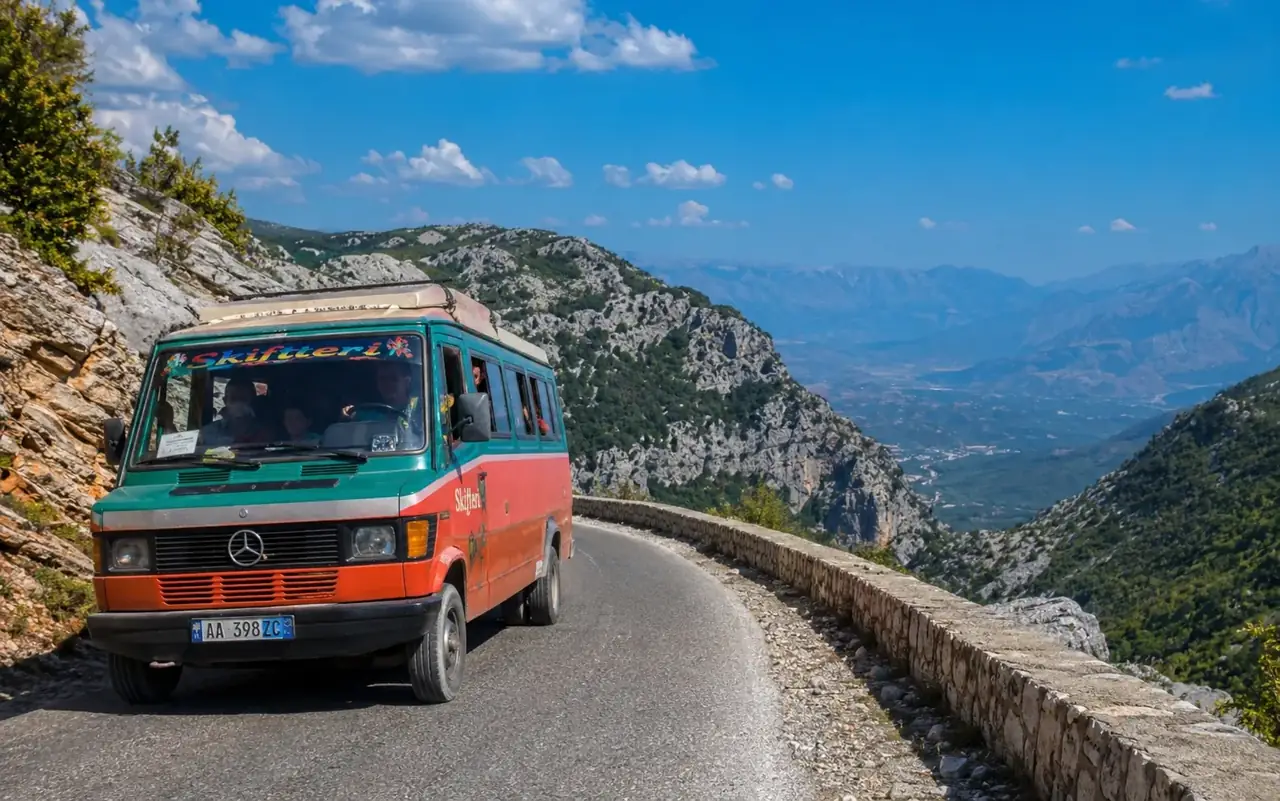
Albania's intercity transport runs on two overlapping systems: scheduled coaches operated by private companies, and furgons — shared minibuses that leave when full rather than on a timetable. Both are cheap and cover almost every town, but neither is run by a single national operator, so routes, departure points and fares are scattered across different companies and, in Tirana's case, several separate pick-up points around the city. This guide covers how to find a bus, where to catch it, roughly what it costs, and what to expect once you're on board.
Buses and furgons: what's the difference
A long-distance bus (coach) usually runs a fixed route at fixed times, is operated by a private company such as the international operator FlixBus or one of dozens of smaller Albanian firms, and increasingly can be found through an online timetable or booking platform. A furgon is a smaller vehicle — typically a van or minibus — serving the same routes, especially shorter or less busy ones, with no published timetable: it leaves once the seats are full. Albania's official tourism portal describes buses as running “constantly during the day” but not always to a fixed schedule, while private vans “operate almost entirely without schedules or set fares,” competing directly with the scheduled services on many of the same roads.
In practice the two blur together: on a busy corridor like Tirana–Durrës you'll see both all day, while on a quieter route to a smaller town a furgon may be the only option, and it might wait 20 minutes or an hour depending on demand.
Finding a route and booking a seat
There's no single official website that sells every ticket, but a few tools cover most of the network:
- Google Maps added Albania's intercity bus data to its trip-planning results, drawing on information from eTransport (the official intercity transport platform), the Municipality of Tirana's public transport system, and private platforms including Gjirafa Travel, according to Alfapress, an Albanian business outlet, reporting in January 2025. Searching a route between two cities can now surface several bus options with rough timings.
- Gjirafa Travel, an online booking platform, lists routes from dozens of Albanian carriers. Its Tirana page cites roughly 710 daily departures from the capital across about 45 operators, with fares starting from €3 and buses running between roughly 00:00 and 23:30; tickets booked through the site are issued digitally rather than printed.
- FlixBus runs its own network through Albania, with direct services from Tirana to dozens of destinations at home and across the region (see below), bookable on its own site or app.
For furgons, and for many smaller Albanian operators that have no website, the fallback is the same as it has always been: turn up at the departure point, ask for your destination by name, and pay the driver in cash (Albanian lek).
Where buses actually leave from in Tirana
Tirana does not have one central bus station, which catches a lot of first-time visitors out. Routes leave from several separate points around the city depending on the destination, and the layout has been changing as the municipality consolidates services into new terminals. The city's own tourism site lists an East Terminal near the TEG shopping centre, used for routes into south-eastern Albania, and a North-South Terminal for other domestic routes, with separate timetable pages for each. Mayor Erion Veliaj has described plans for two new “mega-terminals” — one near TEG in the south-east (the Terminali Lindor) and one at the Kamëz curve (Kthesa e Kamzës) on the western approach to the city, intended to consolidate the north, south and west-bound routes that currently leave from scattered stops.
FlixBus's own route planner, current as of November 2026, confirms several of these points are already in active use: it lists nine Tirana boarding stops for its network, including Tirana East Gate Lindor, the Kthesa e Kamzës DT Station, the Kamzes DT Station, and stops near the airport and the Dinamo stadium. From Tirana, FlixBus advertises direct services to 42 cities, among them Shkodër, Theth and Koman within Albania, and international connections to North Macedonia (Skopje, Ohrid, Struga), Montenegro (Podgorica, Kotor, Budva, Tivat, Bar, Ulcinj, Herceg Novi), Serbia (Belgrade), Bulgaria (Sofia), Greece (Thessaloniki), Croatia (Dubrovnik) and Slovenia (Ljubljana).
The practical upshot: none of Tirana's bus departure points are an easy walk from Skanderbeg Square, so budget for a taxi or ride-hailing trip to reach the right one, and double-check the exact stop on your ticket, on the operator's site, or via Google Maps rather than assuming “the bus station” means one place.
Visit Tirana, the city's tourism site, also publishes separate route-by-route timetable files for north-bound, south-bound, south-east-bound and international buses, each tied to a different departure area. These are a useful starting point for planning, though the files themselves are dated and the terminal layout keeps shifting as the new mega-terminals are built, so treat them as a guide to which general area to head for rather than a guaranteed platform number or departure time.
What it costs
There's no single published fare chart for the whole country, but a few confirmed data points give a sense of scale. On FlixBus, Tirana–Shkodër (85 km) runs four times a day between 05:30 and 21:30, takes at least 1 hour 20 minutes, and starts from €12.98. On Gjirafa Travel, a search for Tirana–Sarandë in November 2026 showed nine daily departures between 07:00 and 22:00, an average fare of €17 and an average journey of just over five hours, run by operators including Tisa Travel, Olgeno Travel & Tours and Transbus Saranda. Fares and schedules on both platforms vary by date, demand and operator, so treat these as a guide rather than a fixed price.
| Route | Typical journey time | Example fare | Source |
|---|---|---|---|
| Tirana – Shkodër | from 1h20 | from €12.98 | FlixBus, Nov 2026 |
| Tirana – Sarandë | around 5h (fastest 4h30) | around €17 average | Gjirafa Travel, Nov 2026 |
| Tirana Airport – Tirana centre | under 1h | 400 lek | Tirana Airport, official site |
Furgons rarely appear on these booking platforms at all. Their fares are set by distance and paid in cash to the driver; no single verified price list exists, so ask the price before boarding, especially if your Albanian is limited — most drivers on common tourist routes are used to the question.
Riding a furgon: what to expect
Furgons gather at the same general departure areas as the scheduled buses, and each one usually shows its destination somewhere visible — a sign in the windscreen or a driver calling out the town's name. There's no ticket counter: you pay the driver or an assistant once you're aboard or as you get off. On busy links near Tirana, a seat rarely takes long to fill; on quieter routes, especially outside the summer season, you may wait longer than you would for a scheduled coach, or find the last one of the day has already gone. If you're relying on a furgon for a day trip to a smaller town, it's worth asking the driver what time the last return service runs, since that information generally isn't published anywhere online.
Getting to and from Tirana Airport
Tirana International Airport's own site lists two bus services. The Rinas Express line to the city, run by LU-NA SHPK, operates 24 hours a day in both directions, departing every full hour, for 400 lek; in Tirana it stops behind the Palace of Opera and Ballet. A separate line connects the airport directly with the North-South Bus Terminal, running hourly from 07:00 to 18:00 towards the airport and 08:00 to 18:00 towards the terminal, for 300 lek — useful if you're flying in and heading straight on to Durrës, Berat, Shkodër or the south without going into central Tirana first.
Know before you go
- Carry cash. Most furgons and many smaller bus operators take Albanian lek only, paid directly to the driver.
- Confirm the departure point, not just the time. Tirana's bus services leave from several separate locations, and the layout is still being consolidated into new terminals, so check the current stop on your ticket, the operator's page, or Google Maps rather than relying on an old guide.
- Book ahead for FlixBus and other platform-listed coaches in peak summer, when seats on popular coastal routes can sell out.
- For furgons, there's nothing to book. Turn up, find the vehicle with your destination displayed, and ask the price and departure time before getting on.
- Build in slack for day trips. Return services thin out in the afternoon on smaller routes, and schedules are not centrally published, so confirm the last departure locally rather than assuming there will be a late option.
- Flying in or out? Factor the airport bus into your schedule rather than a taxi only: at 400 lek on the Rinas Express, or 300 lek on the direct airport–North/South Terminal line, both run hourly and connect you straight to onward buses without a detour into the centre.
For getting around once you're off the bus network, see our guides to driving in Albania and to cash, cards and lek, and our overview of practical travel tips for the country.
Frequently Asked Questions
What's the difference between a bus and a furgon in Albania?
A bus (coach) usually runs on a fixed schedule with a company name and sometimes online booking. A furgon is a smaller shared minibus that leaves once it's full, with no published timetable and fares paid in cash to the driver.
Do I need to book bus tickets in advance in Albania?
For scheduled coaches booked through platforms like FlixBus or Gjirafa Travel, booking ahead is sensible in peak summer on popular routes. Furgons can't be pre-booked at all — you simply turn up and pay the driver.
Where do intercity buses leave from in Tirana?
There is no single central bus station. Routes leave from several points around the city, including an East Terminal near the TEG shopping centre for south-eastern destinations and a North-South Terminal for other domestic routes, plus additional stops used by international operators such as FlixBus. Check your specific departure point on your ticket or via Google Maps.
How much does the bus from Tirana Airport to the city cost?
The airport's own Rinas Express line runs hourly, 24 hours a day, for 400 lek, dropping off behind the Palace of Opera and Ballet in central Tirana, according to Tirana International Airport's website.
Can I pay for buses and furgons by card?
Furgons and many smaller Albanian bus operators take cash only, in lek. Tickets booked online in advance through platforms such as FlixBus or Gjirafa Travel can be paid by card.
Sources9
- Tirana International Airport: Transport & Directions: By Bus
- FlixBus: Bus routes from Tirana
- FlixBus: Tirana to Shkoder bus route
- Gjirafa Travel: Bus to Tirana
- Gjirafa Travel: Tirana to Sarande bus
- Visit Tirana: Interurban transport
- Visit Tirana: Public bus Tirana
- Alfapress: Transporti publik i Shqipërisë hyn më në fund në Google Maps, 2025-01-08
- Bashkia Tiranë (Tirana Municipality): Forumi eTransport: Veliaj, digjitalizimi i shërbimit dhe hapja e dy mega-terminaleve do të shënjojnë një epokë të re për transportin në Tiranë
About this article
Written by the YourAlbania Editorial Team, which covers travel, property and investment in Albania. Every article links to the sources it is based on.
Published 6 November 2026.