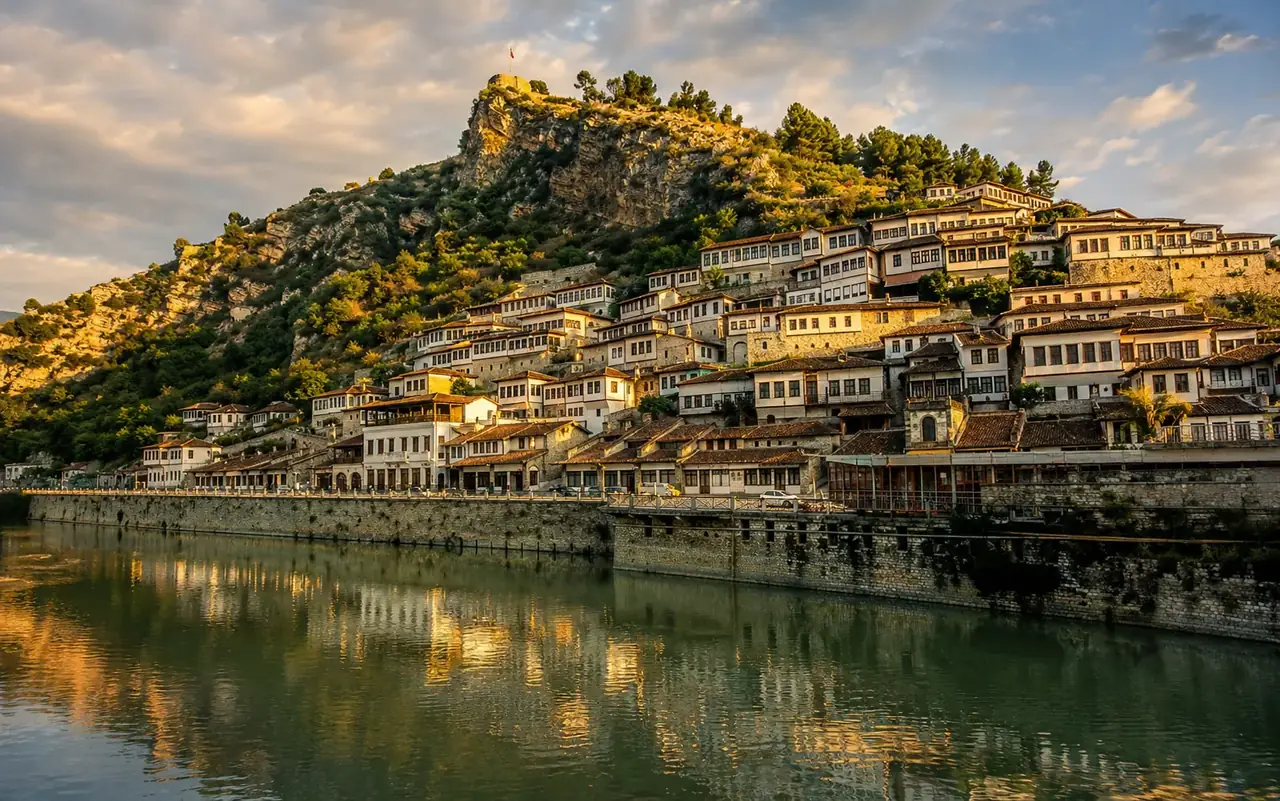
Berat sits on the Osum River in south-central Albania, about 120 km south of Tirana, and is built around a hilltop castle and two historic quarters of stacked white houses facing each other across the river. Its old town has been a UNESCO World Heritage Site since 8 July 2008, and the city has carried the status of a "Museum City" since 1961, according to the Berat municipality. A day is enough to see the castle and both quarters on foot; add a second day, or a guided trip, to reach the Osum Canyon or Mount Tomorr.
A brief history
The hill that the castle now occupies was first settled in the Illyrian period, as the fortified town of Antipatrea, according to Albania's national tourism agency (AKT). The Romans burned it in 200 BC; the walls were strengthened under the Byzantine emperor Theodosius II in the 5th century and rebuilt again under Justinian in the 6th, before the Despot of Epirus, Michael Angelus Comnenus, rebuilt the fortress once more in the 13th century, the period most of the surviving churches date from. Berat passed to Ottoman rule in the 15th century, when its mosques and the Mangalem quarter's houses were built, and the city kept both an Orthodox and a Muslim population through that period. It was designated a Museum City in 1961 and inscribed on the UNESCO World Heritage List in 2008, under the same listing as Gjirokastër, for the quality and completeness of its Ottoman-period architecture.
Getting to Berat
Most visitors arrive from Tirana by intercity bus or furgon (shared minibus). As of November 2026, the booking platform Gjirafa Travel lists around 20 daily departures from Tirana, running from about 06:10 to late afternoon, with online fares of roughly €6–7 and a journey time of around two to two and a half hours. Furgons tend to leave once full rather than to a fixed timetable, so times can shift; ask at the terminal or your accommodation for the current departure point. Our guide to buses and furgons covers how the wider network works, and the driving guide has details on self-drive and car hire if you'd rather go by road on your own schedule.
Berat Castle (Kala)
The castle crowns the hill on the river's right bank and is still inhabited, with narrow lanes running between its churches and old houses. The Berat municipality lists an entrance fee of 100 lek for the castle grounds. According to the municipality, the walls — built up over Roman, Byzantine and medieval phases and reinforced again in the 13th century under the Despot of Epirus, Michael Angelus Comnenus — run for about 400 metres and are studded with 24 defensive towers, enclosing roughly 9.6 hectares. The site originally held some 42 chapels and churches; only eight survive intact today, alongside the ruins of two mosques, including the 15th-century Red Mosque, named for the colour of its brick.
Several of the surviving churches are worth seeking out: the Church of St Mary Vlaherna, described by the municipality as the oldest in Berat (13th century), with 16th-century frescoes attributed to Nicola, son of the painter Onufri; the Church of the Holy Trinity, with Byzantine murals; and the Church of St Theodore, painted by Onufri himself and holding a copy of the 1373 Epitaph of Gllavenica. The highest point, the Acropolis, holds the ruins of Ottoman garrison houses and the White Mosque.
Mangalem: the "City of a Thousand Windows"
Below the castle's southern slope, the Mangalem quarter is the view most photographs of Berat show: terraces of white 18th- and 19th-century houses, each with rows of windows, climbing the hillside towards the fortress. The municipality's own description of the city uses the nickname "Town of a Thousand Windows" for this skyline. Within Mangalem, the Bachelor's Mosque (1827) was built for the city's unmarried craftsmen and has exterior paintings of city scenes, and the small 13th-century Church of St Michael sits on a rock outcrop above the lanes. Nearby, in Berat's old medieval centre, the late 15th-century King's Mosque was built under Sultan Bayezid II, and the 16th-century Leaded Mosque, built under Suleiman the Magnificent, is described by the municipality as the largest mosque of its type in Albania.
Gorica and the old bridge
Across the Osum, the Gorica quarter mirrors Mangalem's stacked houses and is reached over the Gorica Bridge, first built in wood in 1780 by Ahmet Kurt Pasha and rebuilt in stone in the following decades, then again in the 1920s and 1930s. Gorica was historically the Orthodox quarter, and its churches — including the Monastery of St Spiridon and St Thomas's Church, both rebuilt after being destroyed under communist rule — are open daily with free entry, according to the municipality. The ruins of a second, smaller fortress, Gorica Castle, stand on the hill above.
The Onufri National Iconographic Museum
Inside the castle walls, the Cathedral of the Dormition of St Mary (built in 1797 on earlier foundations) now houses the Onufri National Iconographic Museum. It holds around 200 icons and liturgical objects from the 14th to the 20th centuries by masters of the Albanian iconographic school, among them Onufri, his son Nikolla, Onufri the Cypriot and David Selenica, according to Albania's national tourism agency (AKT). Its Baroque iconostasis, carved around 1806–1807, is one of the museum's highlights, along with two manuscripts on UNESCO's Memory of the World register: the 6th-century Codex Purpureus Beratinus and the 9th-century Codex Aureus of Anthimos.
As of November 2026, the Berat municipality gives winter opening hours (1 October to 30 April) as Tuesday to Saturday 09:00–16:00 and Sunday 09:00–14:00, and summer hours (1 May to 30 September) as Tuesday to Saturday 09:00–13:00 and 16:00–19:00, Sunday 09:00–14:00; the museum is closed on Mondays, and a ticket costs 200 lek. Hours and prices at small municipal museums can change, so it's worth confirming locally before planning your day around them. Berat also has an Ethnographic Museum, in a preserved 18th-century house in Mangalem, and the Edward Lear Art Gallery, opened in 1994, if you have time for more than the castle quarter.
Day trips from Berat
Osum Canyon and the Bogovë waterfall
South-east of Berat, the Osum River has carved a canyon that Albania's national tourism agency describes as running more than 26 km with walls reaching up to 80 metres, near the town of Çorovodë. It's protected as a natural monument for its geological and scenic value and is the country's main spot for river rafting, best in spring when snowmelt raises the water level; trails along the rim lead to viewpoints and the Old Zaberzan Bridge, and in summer, with lower water, there are shallow pools for swimming. The Berat municipality puts the canyon area roughly half an hour from the city by road, while travel guides describing the route via the SH72 road through Poliçan and Bogovë give a longer drive, up to about ninety minutes, depending on how far into the canyon you go; a few public minibuses run between Berat and Çorovodë, but on no fixed schedule, so most visitors book an organised day trip or go by hired car.
The Bogovë waterfall, on the same road, is reached by a roughly 45-minute walk from Bogova village and is one of the area's main freshwater sources, according to the municipality; day tours from Berat often combine the canyon and the waterfall in a single outing.
Mount Tomorr
East of the city, Tomorr rises to 2,416 metres and is the highest peak in the Berat region, inside Tomorr National Park. AKT describes the mountain as sacred in Albanian folk tradition, home in legend to the giant Baba Tomorri, and the site of an annual pilgrimage between 20 and 25 August, when the Bektashi community and other visitors climb to a shrine near the summit to honour Abas Ali. Outside the pilgrimage, the park is used for hiking, mountain biking and, in winter, skiing; reaching the upper slopes usually means a full day out from Berat, by 4x4 or on a guided hike, rather than a short detour.
Where to stay
Mangalem and Gorica both have guesthouses and small hotels set in restored Ottoman-era houses, generally a more atmospheric choice than the modern centre near the main boulevard. Staying in Mangalem puts you closest to the castle climb and the old bazaar street below it; Gorica is quieter and gives the classic view back across the river to Mangalem's windows. Book ahead for summer weekends, when the old town's limited number of rooms fills up.
Know before you go
- Cash matters. Entrance fees at the castle and the Onufri museum are paid in lek, and card machines are not reliably available at small ticket booths.
- Dress for churches and mosques. Modest dress is appreciated when visiting the working religious sites inside the castle and in Gorica.
- Wear solid shoes. The lanes in Mangalem, Gorica and the castle are cobbled and steep in places.
- Pace your visit around the river views. The classic view of Mangalem's windows is from Gorica, and vice versa — cross the Gorica Bridge at least once.
- Check museum hours before you go. The Onufri museum and other small sites close on Mondays and keep shorter hours outside summer.
For context on reaching Berat and other Albanian towns by public transport, see our guide to Albania's cities, and for background on the country's Ottoman-era architecture and heritage sites, see the culture guide.
Frequently Asked Questions
How many days do you need in Berat?
One full day covers the castle, Mangalem and Gorica on foot. Add a second day if you want to visit the Osum Canyon, the Bogovë waterfall or Mount Tomorr, which are day trips rather than quick detours.
Is Berat Castle free to enter?
No. The Berat municipality lists an entrance fee of 100 lek for the castle grounds, paid in cash at the gate. The Onufri museum inside the castle walls has a separate ticket, priced at 200 lek as of November 2026.
Why is Berat called the City of a Thousand Windows?
The nickname, used by the Berat municipality itself, refers to the stacked white houses of the Mangalem and Gorica quarters, many with large windows overlooking the town, that climb the hillsides on either side of the Osum River.
How do you get to the Osum Canyon from Berat?
There's no reliable public transport timetable to the canyon near Çorovodë; a few minibuses run but not on a fixed schedule. Most visitors go by hired car or on an organised day trip, which typically includes rafting, hiking or a stop at the Bogovë waterfall.
Is Berat worth visiting if you've already seen Gjirokastër?
Yes. Both are UNESCO-listed Ottoman-era towns, but Berat's two quarters face each other across a river rather than climbing a single hill, and its castle holds a working Orthodox cathedral and iconographic museum that Gjirokastër's does not.
Sources9
- Bashkia Berat (Berat Municipality): Description of Berat, 2026-11-10
- Bashkia Berat (Berat Municipality): The Castle, 2026-11-10
- Bashkia Berat (Berat Municipality): Points of interest to visit, 2026-11-10
- Bashkia Berat (Berat Municipality): Onufri National Museum, 2026-11-10
- Albanian National Tourism Agency (AKT): Onufri National Iconographic Museum, 2026-11-10
- Albanian National Tourism Agency (AKT): Osum Canyon, 2026-11-10
- Albanian National Tourism Agency (AKT): Tomorr National Park, 2026-11-10
- Gjirafa Travel: Buses from Tirana to Berat, 2026-11-10
- Nomads Travel Guide: Osumi River Gorge, 2026-11-10
About this article
Written by the YourAlbania Editorial Team, which covers travel, property and investment in Albania. Every article links to the sources it is based on.
Published 10 November 2026.