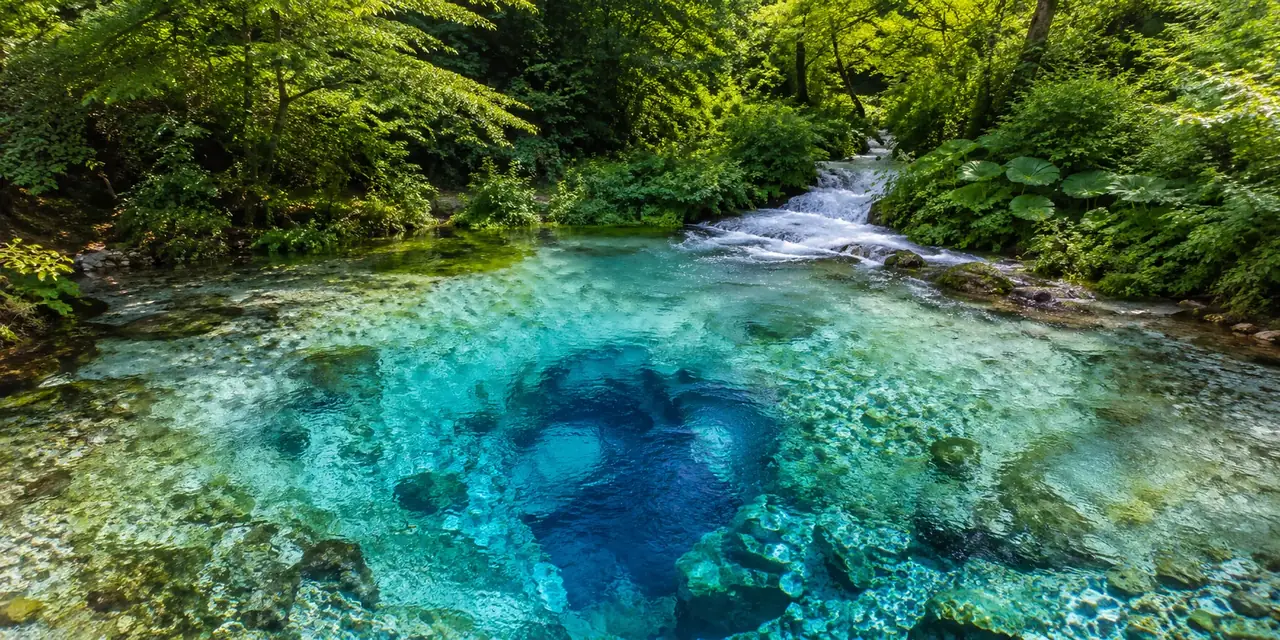
The Blue Eye (Syri i Kaltër) is a karst spring in southern Albania, near the village of Muzinë and about 18 km from Saranda, where deep-blue water rises from a depth of more than 45 metres, according to Albania’s National Tourism Agency (AKT). It is one of the most visited natural sites in the south, reachable by car, furgon, taxi or organised tour. Entry costs a small fee paid in cash, the site generally opens from around 7am to 7pm, and swimming in the main pool is officially against the rules. Here is what to know before you go, checked in November 2026.
What is the Blue Eye?
Syri i Kaltër is a Vaucluse-type karst spring: a nearly circular pool where groundwater forced up under pressure creates a strong blue colour at the centre, fading to a brighter blue at the shallow edges, according to the cave and spring reference site Showcaves.com. AKT describes the water as rising from a depth of more than 45 metres. Showcaves.com adds that cave divers have explored the submerged passage to around 50 metres without finding the bottom, so the spring’s true depth is still not known.
The spring draws on the Mali i Gjerë karst massif, a catchment of roughly 440 km² that straddles the Albania–Greece border and is, Showcaves.com notes, sparsely populated, which is one reason the water is considered clean. Measured flow has been as low as 18.4 litres per second, but output swings widely and quickly with rainfall because the water spends little time underground; after heavy rain the pool can turn cloudy and brown as sediment is stirred up from the cave system. The spring is the main source of the 25 km Bistrica river, which reaches the Ionian Sea south of Saranda.
The site has been protected since the Council of Ministers declared it a Natural Monument on 15 January 1996 (Decision No. 102), a designation AKT says reflects its hydro-geological, aesthetic and tourism value; the protected area covers 180 hectares. A consultation document published on the Ministry of Tourism and Environment’s website proposes reclassifying the site as a Natural Park across a larger area of 293.3 hectares, split into core, traditional-use and recreation zones, with day-to-day management passing to the Vlora regional protected-areas administration. The document carries no posting date and it is not clear from the ministry’s site whether the change has been formally adopted, so for now AKT’s own page still describes the site simply as a Natural Monument.
Getting there
By car
The spring sits off the road between Saranda and Gjirokastër, close to Muzinë. Showcaves.com describes the approach from Saranda as following route SH99 through Çlirim, Mesopotam and Bistricë, with a signposted turn a few kilometres on; from the north, drivers come off the Gjirokastër–Kakavijë highway (SH4) towards Delvinë and pick up SH99 from there. A brown tourist-attraction sign marks the final turn, and the last stretch of road has been described as poorly surfaced, so allow extra time. Use GPS navigation to the car park rather than relying on road numbers alone, since local signage and short diversions change.
Since 2 July 2022, a newer road has linked Gjirokastër and Saranda via Kardhiq and Delvinë, including the roughly 1.3 km Skërfica tunnel. The government said at the time that the new route cuts about 45 minutes off the Saranda journey, Albanian Daily News reported. That is good news if you are driving yourself, but it means through-traffic, including scheduled minibuses, increasingly bypasses the older road past Muzinë altogether – worth bearing in mind if you are relying on public transport (see below).
By bus or furgon
There is no bus that runs directly to the Blue Eye. Travellers without a car have traditionally taken a furgon (shared minibus) running between Saranda and Gjirokastër, paid the driver in cash, and asked to be let out at the signed turn-off, then walked the remaining distance to the car park – a route of about 2 km on a paved path, according to the Balkan travel guides Wander-Lush and Chasing the Donkey, both of which describe the walk as taking roughly 20 to 35 minutes. Because many furgons on this corridor now use the faster tunnel route that bypasses Muzinë (see above), that drop-off point is no longer guaranteed on every departure. Ask the driver before you board whether the service passes the Blue Eye turn-off, and have a backup plan – a taxi or a later furgon – in case it does not. Our guide to Albania’s buses and furgons covers how to flag down and pay for these services generally.
Taxi or organised tour
A taxi from Saranda, agreed and booked for a return trip including waiting time, is the more predictable option if you are not driving; agree the fare before you set off, as described in our guide to driving and car hire in Albania. Organised half-day tours from Saranda, often combined with other stops, can also be booked through hotels, hostels or local operators.
Entrance fee and opening hours
Both Wander-Lush and Chasing the Donkey, in guides most recently updated in January 2026 and late 2023 respectively, put the pedestrian entrance fee at 50 lek per person (roughly €0.40–0.50), paid in cash at a ticket booth near the entrance. The two guides differ on the exact charge for arriving by car, citing figures from around 100 to 200 lek and up for parking depending on how long you stay, so treat any car fee as approximate and keep a mix of small lek notes and coins on hand; card payment is not mentioned as an option by either source. Both guides give the same opening hours: daily, year-round, from 7am to 7pm.
Can you swim in the Blue Eye?
Signs at the site prohibit swimming in the main spring pool, and both Wander-Lush and Chasing the Donkey describe this as the current rule, though each also notes that some visitors wade or swim in despite the signage, with enforcement that is not always consistent. The water itself is a strong deterrent on its own merits: both guides put the temperature at around 10°C even in summer. Dipping your feet at the designated edges is the more common way to experience the water without breaking the posted rule. If you want a swim rather than a look, the nearby Bistrica river and other spots along the coast are better suited, and swimming anywhere in the wider complex outside the main pool is, on current guidance, the safer assumption to make before getting in.
What to expect on site
A short walking route, including a bridge or boardwalk, leads from the car park to the viewing area around the spring. Both guides describe a restaurant at or near the water, along with souvenir stalls, and mention basic visitor facilities such as changing cabins and toilets, though exactly what is open can vary by season. Bring your own water and snacks if you are visiting outside peak hours, and take any litter away with you, since bins at rural Albanian sites can be limited.
Best time to visit
July and August bring the heaviest crowds and the hottest, driest conditions on the approach road and in the car park; both travel guides recommend June or September instead, when the weather is still warm but visitor numbers are lower, or arriving as early in the day as possible if you can only come in high summer. Outside the main season, expect quieter paths but also the possibility that some of the cafes and stalls around the car park will be closed.
Know before you go
- Bring cash in small lek notes and coins; card payment is not mentioned at the entrance or car park by current guides.
- Confirm with a furgon driver whether their route still passes the Blue Eye turn-off before relying on it, since many now use the faster tunnel road between Gjirokastër and Saranda.
- Pack a towel if you plan to dip your feet, and expect very cold water even in summer.
- Arrive early, especially from June to September, to avoid the busiest hours in the car park and on the approach path.
- Combine the visit with a stop in Gjirokastër or with the sights covered in our guide to Albania’s cities, since the spring sits roughly on the route between the two.
Fees, hours and access details above reflect travel guides checked and government pages read in November 2026; confirm current prices and transport options locally before you travel, since rural entrance fees and bus routings in Albania change from one season to the next.
Frequently Asked Questions
Can you swim in the Blue Eye in Albania?
Signs at the site prohibit swimming in the main spring pool, and recent visitor guides describe this as the current rule, though enforcement is inconsistent and some visitors still get in. The water stays around 10°C even in summer; dipping your feet at the edge is the more common way to experience it without swimming.
How much does it cost to visit the Blue Eye?
Recent guides put the pedestrian entrance fee at around 50 lek (about €0.40–0.50) per person, paid in cash. Fees for arriving by car vary by source, roughly 100–200 lek or more depending on how long you stay, so bring a mix of small notes and coins.
What are the Blue Eye's opening hours?
The site is generally open daily, year-round, from around 7am to 7pm, according to current visitor guides.
How do I get to the Blue Eye without a car?
Furgons (shared minibuses) running between Saranda and Gjirokástër have traditionally dropped passengers at a signed turn-off about 2 km from the spring, but many now use a faster road through the Skërfica tunnel that bypasses this stop. Ask the driver before boarding, or book a taxi or an organised tour from Saranda instead.
How deep is the Blue Eye spring?
Albania's National Tourism Agency says the water rises from a depth of more than 45 metres. Cave divers have explored the submerged passage to around 50 metres without reaching the bottom, so the spring's true depth remains unknown.
Sources6
- Albanian National Tourism Agency (akt.gov.al): Syri i Kaltër (Blue Eye)
- Ministry of Tourism and Environment: Consultation: reclassification of the Syri i Kaltër protected area (RENJK 379)
- Showcaves.com: Syri i kaltër
- Albanian Daily News: New Road towards Saranda Inaugurated
- Wander-Lush: How to Visit Albania's Two Blue Eyes, Syri i Kalter & the Blue Eye of Theth, 2026-01
- Chasing the Donkey: 2026 Guide To The Blue Eye In Albania (Syri i Kalter), 2026-01-07
About this article
Written by the YourAlbania Editorial Team, which covers travel, property and investment in Albania. Every article links to the sources it is based on.
Published 17 November 2026.