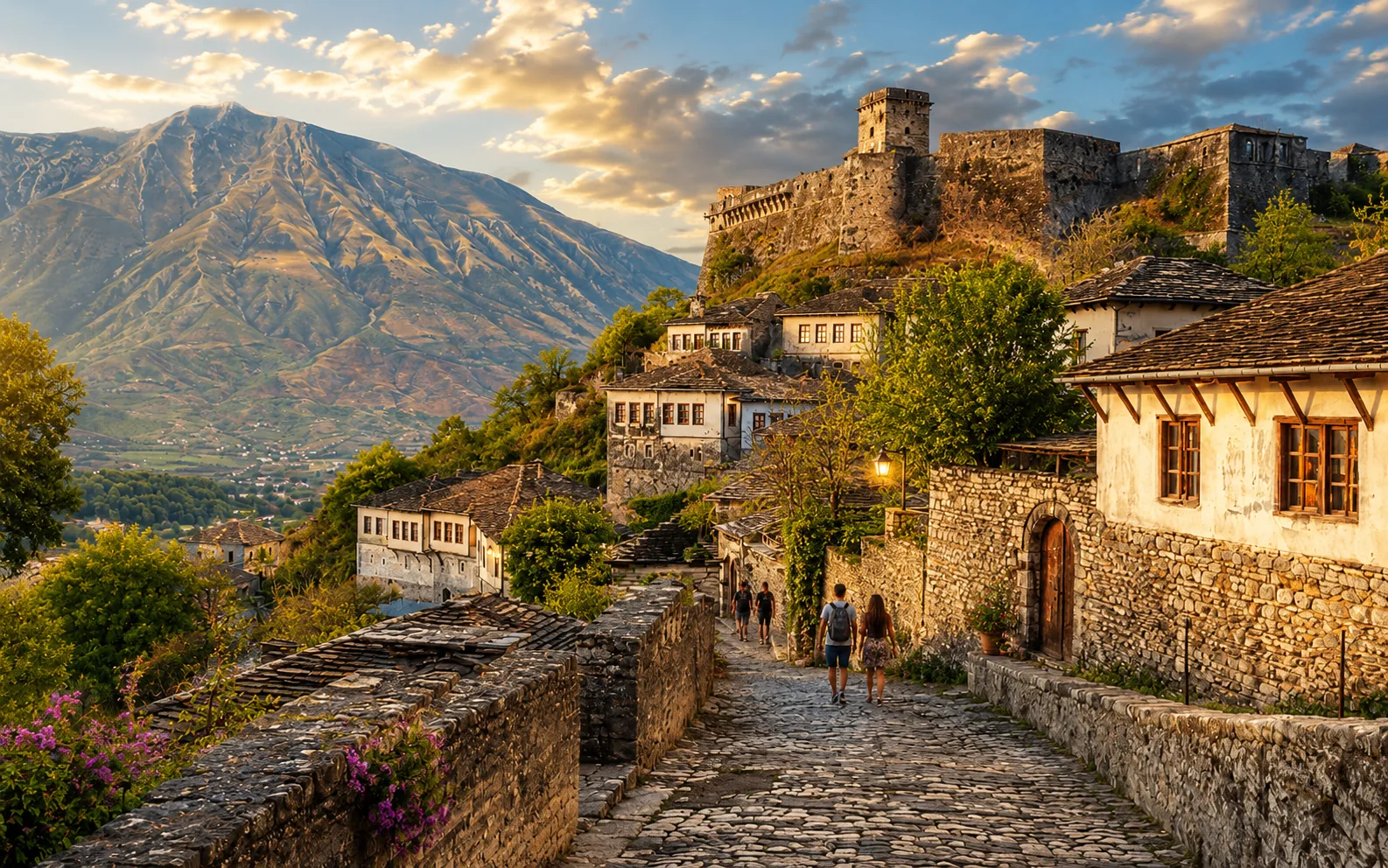
Gjirokastër is a hill town in southern Albania, built in tiers of grey stone houses on the slopes of Mount Gjërë above the Drino Valley. It is known as the "City of Stone," and its old town, centred on a hilltop castle and an Ottoman-era bazaar, has been a UNESCO World Heritage Site since 2005. A day on foot covers the castle, the bazaar and two or three of the historic tower houses; a second day leaves room for the Antigonea ruins outside town.
A brief history
Gjirokastër's position above the Drino Valley gave it a defensive role controlling routes between Epirus, inland Albania and Greece, and AKT dates the town's documented history back to the medieval period. It reached its greatest prosperity between the 17th and 19th centuries under Ottoman rule, when wealthy families built the multi-storey stone tower houses — with thick lower walls, small defensive windows and stone-tiled roofs — that still define the old town today. That architecture, along with the fortified commercial character of the bazaar, is what earned the town's old quarter its place on the UNESCO World Heritage List, inscribed as the Museum-City of Gjirokastra in 2005; Berat was added to the same joint listing as an extension in 2008.
Getting to Gjirokëster
Most visitors arrive by road. As of November 2026, the booking platform Gjirafa Travel lists around 11 daily bus departures between Tirana and Gjirokastër, run mainly by the operators Tirka 2000 and Argjiro, from about 05:00 to 20:30, with online fares around €13.50 and a journey time of roughly three and a half to four hours. The same platform lists direct transfer buses from Tirana International Airport (Rinas), run by Luna Travel and Argjiro, at around €18. According to the Gjirokastra Foundation, a heritage organisation based in the town, buses from Tirana leave from the South Bus Station on Kavaja Street and arrive at a roundabout in the lower part of Gjirokastër; a taxi from the airport or bus stop up into the old town costs a few hundred lek, since the old town's lanes are steep and cobbled.
Coming from the coast, Gjirafa Travel lists buses and furgons (shared minibuses) between Saranda and Gjirokastër, run by Argjiro and Trans Butrinti, at around €6 for the roughly 50 km journey, with a listed travel time of about an hour by direct bus, longer by furgon with stops. Travellers crossing overland from Greece can cross at the Kakavia border post, where Greek buses run from Ioannina several times a day and Albanian minibuses and taxis continue on to Gjirokastër, according to the Gjirokastra Foundation; driving from Tirana by car takes about three and a half hours over roughly 230 km. Our guide to buses and furgons covers how the wider network works if you're combining this with other towns.
Gjirokastër Castle
The castle sits at the top of the town and is, according to Albania's National Tourism Agency (AKT), one of the largest and best-preserved in the country, with panoramic views over the Drino Valley and museums, galleries and historical objects inside its walls. The Gjirokastra Foundation lists the castle as open year-round, April to September from 09:00 to 19:00 and October to March from 09:00 to 17:00, with an admission fee of 200 lek that also covers the two small museums inside: a city-history museum opened in 2012, and the National Museum of Armaments, which traces Albanian weaponry from 1912 to the Second World War and opens into part of the former prison that operated inside the castle under the communist government. Other features noted by the Foundation include an artillery gallery, a US Air Force training plane displayed as a Cold War-era trophy, the stage used for the National Folklore Festival, and a clock tower, which the Foundation's own site notes is not currently working. A small Bektashi turbe, or tomb, stands near the main gate.
Below the castle, a separate Cold War Tunnel — an underground shelter opened to visitors in 2014 — can be visited for a small fee; the Gjirokastra Foundation advises checking current hours and admission at the town's Info Point on Çerçiz Square rather than relying on a fixed schedule, since access has varied by season.
The old bazaar and the stone tower houses
Below the castle, the old bazaar is Gjirokastër's historic commercial quarter: narrow cobbled streets lined with artisan workshops in wood, stone and metal, along with shops, bars and restaurants, according to AKT. Several fortified Ottoman-era tower houses in and around the bazaar are open to visitors, generally for a small admission fee rather than on a fixed schedule:
- Zekate House, built in 1811–1812, is a grand twin-towered house with wide eaves and views over the town; the Gjirokastra Foundation says a family member living nearby typically unlocks it for visitors, for around 200 lek.
- Skënduli House, built in 1823, has a decorated guest room and defensive features typical of the period; it is also opened for visitors by a family member, for a similar fee.
- Kadare House, the childhood home of the writer Ismail Kadare, was rebuilt after a fire in 1997 and holds an exhibition on his life and work; the Foundation lists it as open April to October, 09:00 to 19:00, for 200 lek.
- Babameto House, a restored 19th-century house in the bazaar, is now run by the Gjirokastra Foundation as a heritage and culture centre with a hostel; entry is free, with a donation box.
The town's Ethnographic Museum, in a restored house in the old quarter, covers local domestic life and is listed by the Gjirokastra Foundation as open April to September from 08:00 to 12:00 and 16:00 to 19:00, and October to March from 08:00 to 16:00, for 200 lek. Hours and prices at these small, family- or foundation-run sites can change between seasons, and card payment isn't always available, so it's worth carrying cash and confirming on arrival, ideally at the town's Info Point.
Other bazaar-area sights mentioned by the Foundation include the 1757 Bazaar Mosque, the Seven Fountains complex, St Sotiri Church (which holds a Sunday service at 07:00), and the remains of piers from an aqueduct built under Ali Pasha of Tepelena, who held the region in the early 19th century.
Antigonea: a day trip into the Drino Valley
About 14 km east of Gjirokastër, near the village of Saraqinisht, the Antigonea archaeological park preserves the remains of a fortified city founded in 295 BC by Pyrrhus, King of Epirus, who named it after his first wife, Antigone, according to AKT. The agency describes a 3rd- and 2nd-century-BC settlement with roughly four kilometres of defensive walls that was a centre of political, economic and cultural life in the region, and the site today includes mosaics, columns, a stone promenade and an ancient stone scale among its ruins. AKT notes that the wider Drino Valley holds more than 20 ancient settlements and sites, of which Antigonea is the largest.
Food: qifqi
Gjirokastër's best-known dish is qifqi, made from rice (or, in the version described by AKT, eggs, fresh cheese and flour with aromatic herbs) mixed and shaped into small balls or patties, then cooked in a pan. It's served as a starter or light meal in bazaar restaurants, and is specific enough to the town that it's worth ordering there rather than elsewhere in the country.
Beyond the old town
AKT lists several sites within easy reach of Gjirokastër for travellers with extra time, beyond Antigonea. Lake Viroi sits about 3 km northwest of the town, and the Hotovë-Dangëlli National Park, which AKT describes as the largest protected area in the Gjirokastër district, lies in the hills further out; the Cepo Monastery is also in the surrounding hills. None of these have the visitor infrastructure of the old town's sights, so treat them as a drive or guided excursion rather than a casual add-on to a day exploring the bazaar.
When to go
Summer (June to August) is the busiest and hottest season, with the castle and museums keeping their longest hours; spring and autumn bring cooler weather for walking the old town's slopes and are the better choice if you'd rather avoid midday heat and tour groups. Gjirokastër also hosts Albania's National Folklore Festival, though not every year; for current dates and a fuller look at the country's festival calendar, see our culture guide. For a month-by-month breakdown of weather and crowds across the country, see our guide to the best time to visit Albania.
Know before you go
- Carry cash. Castle, museum and house tickets are priced in lek, and card or QR payment is not reliable at small ticket points.
- Wear solid shoes. The old town's lanes and the climb to the castle are steep, cobbled and slippery when wet.
- Some houses open on request. Zekëate and Skënduli Houses don't keep fixed hours; a family member answers the door, so visit earlier in the day if you can.
- A taxi helps with luggage. The old town sits well above the bus station and roundabout in lower Gjirokastër; a short taxi ride avoids the climb with bags.
- Confirm hours locally. Seasonal opening times at the Cold War Tunnel and smaller museums change; the town's Info Point on Çerçiz Square has current details.
For how Gjirokastër compares with Albania's other UNESCO hill town, see our Berat travel guide, and for an overview of the country's towns and cities, see our cities guide.
Frequently Asked Questions
How many days do you need in Gjirokastër?
One full day covers the castle and the old bazaar's tower houses on foot. Add a second day, or a half-day trip, to see the Antigonea archaeological park outside town.
Is Gjirokastër Castle free to enter?
No. The Gjirokastra Foundation lists an admission fee of 200 lek, which also covers the two small museums inside the castle walls. Prices at small heritage sites can change, so it's worth confirming on arrival.
How do you get from Tirana to Gjirokastër?
By intercity bus, run by operators including Tirka 2000 and Argjiro, taking roughly three and a half to four hours for around €13.50 as of November 2026, according to the booking platform Gjirafa Travel. Direct transfer buses also run from Tirana International Airport.
Can you visit Gjirokastër as a day trip from Saranda?
Yes. Buses and furgons connect Saranda and Gjirokastër in around an hour for about €6, according to Gjirafa Travel, making it a feasible day trip from the coast.
What is qifqi?
Qifqi is Gjirokastër's best-known local dish, made from rice or egg-and-cheese batter mixed with herbs and shaped into small balls or patties before being cooked in a pan. It's served as a starter or light meal in the town's bazaar restaurants.
Sources9
- Albanian National Tourism Agency (AKT): Gjirokastra (city page), 2026-11-13
- Albanian National Tourism Agency (AKT): Archaeological Antigoneia, 2026-11-13
- Albanian National Tourism Agency (AKT): The Kite (qifqi), 2026-11-13
- Gjirokastra Foundation: Things to do/see in Gjirokastra, 2026-11-13
- Gjirokastra Foundation: Getting to Gjirokastra, 2026-11-13
- Gjirafa Travel: Buses from Tirana to Gjirokastër, 2026-11-13
- Gjirafa Travel: Transfer from Tirana Airport to Gjirokastër, 2026-11-13
- Gjirafa Travel: Buses from Gjirokastër to Saranda, 2026-11-13
- In Your Pocket: Zekate House, 2026-11-13
About this article
Written by the YourAlbania Editorial Team, which covers travel, property and investment in Albania. Every article links to the sources it is based on.
Published 13 November 2026.